OSPF Multi-Area Configuration


OSPF Multi-Area Configurationg


We will use the following topology:
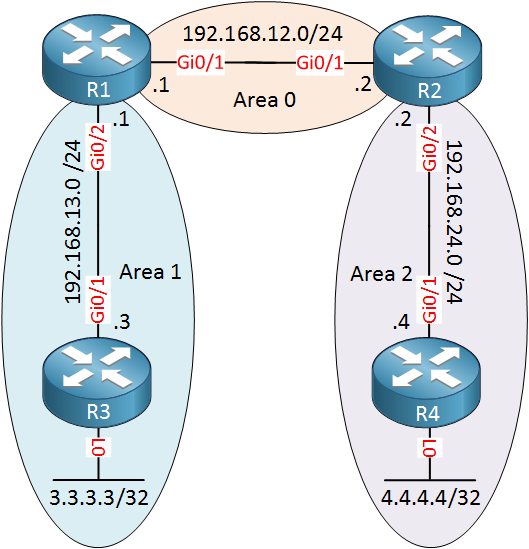
ospf two areas multi area

Above we have R1 and R2 in area 0, the backbone area. Between R1 and R3, we will use area 1 and between R2/R4 we will use area 2. R3 and R4 have a loopback interface with an IP address that we will advertise in their area.

Configuration


Let’s start with all network commands to get OSPF up and running. The network command defines to which area each interface will belong.First, we will configure R1 and R2 for the backbone area:

R1(config)#router ospf 1
R1(config-router)#network 192.168.12.0 0.0.0.255 area 0
R2(config)#router ospf 1
R2(config-router)#network 192.168.12.0 0.0.0.255 area 0

Let’s configure R1 and R3 for area 1:

R1(config)#router ospf 1
R1(config-router)#network 192.168.13.0 0.0.0.255 area 1
R3(config)#router ospf 1
R3(config-router)#network 192.168.13.0 0.0.0.255 area 1
R3(config-router)#network 3.3.3.3 0.0.0.0 area 1

And last but not least, R2 and R4 for area 2:

R2(config)#router ospf 1
R2(config-router)#network 192.168.24.0 0.0.0.255 area 2
R4(config)#router ospf 1
R4(config-router)#network 192.168.24.0 0.0.0.255 area 2
R4(config-router)#network 4.4.4.4 0.0.0.0 area 2

Those are all the network commands we need.

Verification

Let’s verify our work. First, let’s make sure we have OSPF neighbors:

R1#show ip ospf neighbor 

Neighbor ID     Pri   State           Dead Time   Address         Interface
192.168.24.2      1   FULL/DR         00:00:36    192.168.12.2    GigabitEthernet0/1
3.3.3.3           1   FULL/BDR        00:00:34    192.168.13.3    GigabitEthernet0/2

R1 has formed a neighbor adjacency with R2 and R3. Let’s check R2:

R2#show ip ospf neighbor

Neighbor ID     Pri   State           Dead Time   Address         Interface
192.168.13.1      1   FULL/BDR        00:00:34    192.168.12.1    GigabitEthernet0/1
4.4.4.4           1   FULL/BDR        00:00:30    192.168.24.4    GigabitEthernet0/2

R2 has formed neighbor adjacencies with R1 and R4. The show ip ospf neighbor command, however, doesn’t tell me anything about the areas that are used. If you want to see this, you could add the detail parameter like this:

R2#show ip ospf neighbor detail 
 Neighbor 192.168.13.1, interface address 192.168.12.1
    In the area 0 via interface GigabitEthernet0/1
    Neighbor priority is 1, State is FULL, 6 state changes
    DR is 192.168.12.2 BDR is 192.168.12.1
    Options is 0x12 in Hello (E-bit, L-bit)
    Options is 0x52 in DBD (E-bit, L-bit, O-bit)
    LLS Options is 0x1 (LR)
    Dead timer due in 00:00:33
    Neighbor is up for 00:17:30
    Index 1/1/1, retransmission queue length 0, number of retransmission 0
    First 0x0(0)/0x0(0)/0x0(0) Next 0x0(0)/0x0(0)/0x0(0)
    Last retransmission scan length is 0, maximum is 0
    Last retransmission scan time is 0 msec, maximum is 0 msec
 Neighbor 4.4.4.4, interface address 192.168.24.4
    In the area 2 via interface GigabitEthernet0/2
    Neighbor priority is 1, State is FULL, 6 state changes
    DR is 192.168.24.2 BDR is 192.168.24.4
    Options is 0x12 in Hello (E-bit, L-bit)
    Options is 0x52 in DBD (E-bit, L-bit, O-bit)
    LLS Options is 0x1 (LR)
    Dead timer due in 00:00:31
    Neighbor is up for 00:15:57
    Index 1/1/2, retransmission queue length 0, number of retransmission 0
    First 0x0(0)/0x0(0)/0x0(0) Next 0x0(0)/0x0(0)/0x0(0)
    Last retransmission scan length is 0, maximum is 0
    Last retransmission scan time is 0 msec, maximum is 0 msec

Above you can see that interface GigabitEthernet0/1 is in area 0 and interface GigabitEthernet0/2 is in area 2. Another good command to find area information is show ip protocols:

R2#show ip protocols 
*** IP Routing is NSF aware ***

Routing Protocol is "application"
  Sending updates every 0 seconds
  Invalid after 0 seconds, hold down 0, flushed after 0
  Outgoing update filter list for all interfaces is not set
  Incoming update filter list for all interfaces is not set
  Maximum path: 32
  Routing for Networks:
  Routing Information Sources:
    Gateway         Distance      Last Update
  Distance: (default is 4)

Routing Protocol is "ospf 1"
  Outgoing update filter list for all interfaces is not set
  Incoming update filter list for all interfaces is not set
  Router ID 192.168.24.2
  It is an area border router
  Number of areas in this router is 2. 2 normal 0 stub 0 nssa
  Maximum path: 4
  Routing for Networks:
    192.168.12.0 0.0.0.255 area 0
    192.168.24.0 0.0.0.255 area 2
  Routing Information Sources:
    Gateway         Distance      Last Update
    4.4.4.4              110      00:16:04
    192.168.13.1         110      00:16:53
  Distance: (default is 110)

Above you can see which networks belong to which area:

  • Network 192.168.12.0 in area 0.
  • Network 192.168.24.0 in area 2.

Let’s check our routing tables. Let’s start with R1:

R1#show ip route ospf
Codes: L - local, C - connected, S - static, R - RIP, M - mobile, B - BGP
       D - EIGRP, EX - EIGRP external, O - OSPF, IA - OSPF inter area 
       N1 - OSPF NSSA external type 1, N2 - OSPF NSSA external type 2
       E1 - OSPF external type 1, E2 - OSPF external type 2
       i - IS-IS, su - IS-IS summary, L1 - IS-IS level-1, L2 - IS-IS level-2
       ia - IS-IS inter area, * - candidate default, U - per-user static route
       o - ODR, P - periodic downloaded static route, H - NHRP, l - LISP
       a - application route
       + - replicated route, % - next hop override, p - overrides from PfR

Gateway of last resort is not set

      3.0.0.0/32 is subnetted, 1 subnets
O        3.3.3.3 [110/2] via 192.168.13.3, 00:01:47, GigabitEthernet0/2
      4.0.0.0/32 is subnetted, 1 subnets
O IA     4.4.4.4 [110/3] via 192.168.12.2, 00:00:54, GigabitEthernet0/1
O IA  192.168.24.0/24 [110/2] via 192.168.12.2, 00:01:44, GigabitEthernet0/1

Above we see three OSPF entries. The first one is for 3.3.3.3/32, the loopback interface of R3. It shows up with an O since this is an intra-area route. R1 has also learned about 4.4.4.4/32 and 192.168.24.0/24. These two entries show up as O IA since they are inter-area routes.

R2 has a similar output:

R2#show ip route ospf

      3.0.0.0/32 is subnetted, 1 subnets
O IA     3.3.3.3 [110/3] via 192.168.12.1, 00:02:19, GigabitEthernet0/1
      4.0.0.0/32 is subnetted, 1 subnets
O        4.4.4.4 [110/2] via 192.168.24.4, 00:01:29, GigabitEthernet0/2
O IA  192.168.13.0/24 [110/2] via 192.168.12.1, 00:02:24, GigabitEthernet0/1

Above we see that R2 has learned about 3.3.3.3/32 and 192.168.13.0/24 which area inter-area routes. 4.4.4.4/32 is an intra-area route.

Let’s check R3:

R3#show ip route ospf

      4.0.0.0/32 is subnetted, 1 subnets
O IA     4.4.4.4 [110/4] via 192.168.13.1, 00:01:57, GigabitEthernet0/1
O IA  192.168.12.0/24 [110/2] via 192.168.13.1, 00:02:50, GigabitEthernet0/1
O IA  192.168.24.0/24 [110/3] via 192.168.13.1, 00:02:47, GigabitEthernet0/1

Everything that R3 has learned is from another area, that’s why we only see inter-area routes here. The same thing applies to R4:

R4#show ip route ospf

      3.0.0.0/32 is subnetted, 1 subnets
O IA     3.3.3.3 [110/4] via 192.168.24.2, 00:02:13, GigabitEthernet0/1
O IA  192.168.12.0/24 [110/2] via 192.168.24.2, 00:02:13, GigabitEthernet0/1
O IA  192.168.13.0/24 [110/3] via 192.168.24.2, 00:02:13, GigabitEthernet0/1

Just to be sure, let’s try a quick ping between R3 and R4 to prove that our multi-area OSPF configuration is working:

R3#ping 4.4.4.4 source 3.3.3.3
Type escape sequence to abort.
Sending 5, 100-byte ICMP Echos to 4.4.4.4, timeout is 2 seconds:
Packet sent with a source address of 3.3.3.3 
!!!!!
Success rate is 100 percent (5/5), round-trip min/avg/max = 9/11/13 ms

Our ping is successful. That will be all for now.

Hot Standby Router Protocol (HSRP)


Hot Standby Router Protocol (HSRP)


#cybersecurity #coursera #quiz #solution #network
HSRP 2 different networks configurations and verification


Hot Standby Router Protocol (HSRP) is a CISCO proprietary protocol, which provides redundancy for a local subnet. In HSRP, two or more routers gives an illusion of a virtual router.

HSRP allows you to configure two or more routers as standby routers and only a single router as an active router at a time. All the routers in a single HSRP group shares a single MAC address and IP address, which acts as a default gateway to the local network. The Active router is responsible for forwarding the traffic. If it fails, the Standby router takes up all the responsibilities of the active router and forwards the traffic.

Some important terms related to HSRP :

  1. Virtual IP : IP address from local subnet is assigned as default gateway to all local hosts in the network.
  2. Virtual MAC address : MAC address is generated automatically by HSRP. The first 24 bits will be default CISCO address (i.e. 0000.0c). The next 16 bits are HSRP ID (i.e. 07.ac). The next 8 bits will be the group number in hexadecimal. e.g- if the group number is 10 then the last 8 bits will be 0a.
     
    Example of virtual MAC address –
    0000.0c07.ac0a
  3. Hello messages : Periodic messages exchanged by active and standby routers. These messages are exchanged after every 3 seconds telling the state of router.
  4. Hold down timer : Its default value is 10 seconds i.e roughly 3 times the value of hello message. This timer tells us about the router that how much time will the standby router waits for hello message if it is not received on time.

    Note : If the active router fails then the standby router will become the active router.

  5. Priority : By default, the priority value is 100. It is helpful when the active router comes back after falling down, we can change the priority of standby router (which has become the active router after the original active router is down) to less than 100 therefore it again becomes standby router.

    Note : The router having higher priority will become the active router.

  6. Preempt : It is a state in which the standby router automatically becomes the active router.

WORKING :

Members having same group ID are the members of same group. One of the member of the group will be elected as the active router while others remain as standby routers. The virtual IP is configured as default gateway of all the hosts in the local subnet and the active router is responsible for forwarding the traffic of local hosts. If the active router goes down then the hello messages are not exchanged between the active and the standby routers therefore the standby router waits until the hold-down timer time. As soon as the hold down time is finished, the standby router will become the active router and take up all the responsibilities of active router. This is known as preempt.
If in case the original active router comes back then we can decrease the priority of the standby router so that it will become the standby router again.

Hot Standby Router Protocol (HSRP) has 2-versions :

version 1 : The messages are multicast at 224.0.0.2 and uses the UDP port 1985. This version allows group number range from 0 to 255.
version 2 : The messages are multicast at 224.0.0.102 and uses the UDP port 1985. This version allows group number range from 0 to 4095.

SSL Certificates: Make the Right Choice

 SSL Certificates: Make the Right Choice

#cybersecurity #coursera #quiz #solution #network #python


Increasingly sophisticated techniques are being used to hack into data today. So it has become extremely important to use even better ways to protect your customers’ data. SSL certification is one such way. This article looks at the different types of SSL certificates and how to choose one that suits your organisation.

SSL certificates are an apt solution for securing data in transit. They create an automated mechanism to encrypt the transfer of data between the server and browser (or site and visitor). This encryption can only be decrypted by the intended system. So it discourages hackers from stealing data, and offers complete security against transit attacks on it.

Along with securing communication, SSL certificates also build trust with customers and help you emerge as a credible business by displaying virtual trust icons like a padlock, HTTPS prefix, and a green address bar. So let’s learn about the major types of SSL certificates and how to choose the one that works best for you.


SSL certificate options: Similarities and differences
Let’s first discuss the basic similarity all SSL certificates share. Regardless of their type, price and scope, every SSL certificate encrypts the to-and-fro communication between the site’s server and the Internet browser of your visitor.

The difference lies in the terms and conditions of the validation process and the number of domains/subdomains it covers, etc. Proceeding to purchase an SSL certificate without first reviewing your present and future needs may result in costly mistakes, and you may end up paying a hefty amount for advanced features that are irrelevant to your business. Or you may get tempted to buy a cheap certificate that isn’t a perfect fit for your business needs.
Due to the crucial role it plays, an SSL certificate is issued by an official certificate authority after a thorough verification procedure to confirm the legitimacy of ownership. So, this certificate not only encrypts the communication between websites and audiences, but also ensures the legal position of a site. It plays a vital role in building trust.

As you have now understood why we need a SSL certificate, we can discuss the different types of popular SSL certificates, along with their benefits and issuance procedures.


Domain validation (DV) SSL certificate
The most basic of the three types of SSL certificates, the DV or domain validation certificate confirms the ownership of a domain through an automated online process. All you have to do is to complete a few basic steps to prove that you are the legitimate owner of the domain to get this certificate. Though easiest to get, this type of certificate helps in building only a basic level of trust.

After completing the DV certification procedure, you are allocated trust-building visual elements — a static seal, a padlock icon, and an HTTPS prefix in your URL.

Cheapest prices and quick, automated processes are the two major benefits of a DV certificate. On the flip side, you get only the basic trust signs that aren’t enough to satisfy the security concerns of more demanding customers or visitors.

Important to know: DV misses the most important trust sign — vetting the real, legal business that owns the domain name. For instance, suppose Mr X buys a domain ‘abc.com’ to lure gullible people into investing money in a business that seems genuine. Being a legitimate domain owner, he can get a DV through an automated process. With HTTPS URLs and other trust signs, it is easy to gain people’s trust too. However, the company (or fraud mechanism) behind this domain isn’t vetted/verified, which makes it easier for Mr X to continue duping investors of their hard-earned money.

Is DV SSL the right choice for you?: DV is best for a small and general website, which doesn’t demand or require any sensitive information that can be misused like credit card numbers, social security information, or details of a financial portfolio. For websites that post children’s stories, general e-magazines, personal blogs, professional portfolios, and other static websites on general topics, a DV certificate is a perfect and cheap solution. Securing more mission-critical sites that collect sensitive data like credit card numbers and social security details is a different story though.

Organisation validation (OV) SSL certificate
As the name suggests, the OV certificate not only validates the domain ownership but also vets the real identity of the organisation to which the domain officially belongs. It builds an extra layer of trust for visitors who have stronger concerns, by displaying the key information about the business. Interested visitors just need to check the details of the certificate to ascertain the credibility of the company.

As compared to a DV certificate, an OV certification requires a more detailed process carried out by an authorised certificate authority that demands and vets key documents representing the legal status of the company. Hence, along with domain ownership, this certificate also assures that it is owned by a legitimate organisation.

Though the issuance process is more expensive and demanding, this type of certificate does empower you to position your company as a legal, real company doing legitimate business. It makes you stand out and even more concerned visitors are able to trust your organisation.

Is OV the right choice for you?: Sites that ask for sensitive data that can be misused by threat actors should obtain this certificate. E-commerce sites with online payment gateways, digital health practitioners, government websites that demand citizens’ information, defence-related websites, online trading platforms, or professional networking sites are all the right candidates for obtaining an OV certificate.

Extended validation (EV) SSL certificate
In the digital domain, visuals matter a lot. A company seal, security icons, or even assuring colours (like green) can go a long way in leaving a lasting impression, winning you a big deal or helping you forge business relations with dynamic brands.

The vetting procedure for issuing an EV SSL certificate is quite stringent and involves a manual process as well. It starts by verifying the ownership of the domain. After that, the certification authority asks for your identification number. Next, it gets your legal working contact number from relevant authentic sources. That contact number is manually verified by calling your office and talking with the real person. Only after satisfying all such verification parameters can you get the EV certificate.

Unlike an OV certificate, you don’t just get a static site seal with a basic look, but get dynamic seals as well. Additionally, the full legal company name is displayed in the address bar along with a green-coloured padlock. Added to this, the entire address bar turns green as soon as your site loads. All these visible signs vouch for the legality of your firm, build a ‘visual comfort zone’ and reaffirm the credibility of your organisation.

Such certificates satisfy the sophisticated digital security vetting parameters of global brands and corporate conglomerates. If highly expensive items like gold and diamond jewellery are being sold on a website, then such superior trust factors satisfy the higher trust demands of buyers. Though this certificate is the most expensive among all the SSL certificates, it is worth investing in the extra dollars as it has the potential to significantly boost your sales revenue.

Scope of different SSL certificates
Apart from the type of certificate, the other crucial question is: how many digital properties you want your certificate to cover? If you own a single domain property and do not want to expand in the foreseeable future, then a single DV would do for you. But what if you own, say, 20 different domains — most of which deal with e-commerce or collect sensitive client information? It wouldn’t be practical to buy the more expensive EV certificate for each of these domains. Here is some guidance on that.

Wildcard SSL certificate
With a single wildcard SSL certificate you can protect the main domain and practically unlimited sub-domains related to it. For instance, yoursite.com (the main domain) may have three subdomains:

  • mail.yoursite.com
  • login.yoursite.com
  • ftp.yoursite.com

This certificate relieves you from the stress and expenses of purchasing a separate certificate for every domain after going through the complete validation process, followed by an installation process for each. It also saves you a lot of time on repetitive processes and almost eliminates potential errors.

Note: Both DV and OV offer wildcard certificate options.

Multi-domain (or SAN SSL) certificate
One level above the wildcard SSL certificate is the multi-domain certificate, which helps to secure primary domains and their related subdomains. It does everything that a wildcard certificate can do, and more. If you own multiple domains and want a uniform and standard SSL security for all, then a multi-domain certificate is the right choice for you.

Is SSL certification only about visual trust signs?
Obviously, when you spend significant money on an SSL certificate you would like to get more than security icons or trust signals. Well, your certification authority does offer a specific amount of warranty or a payback if your customers become victims of a fraud. The amount of this warranty depends upon the type of certificate and how much it costs.

How to choose the ideal certificate authority (CA) for SSL
The next question is: who can judge the judge? It is you. Carefully consider some of the prime factors while finding the right SSL certificate provider/CA for your site. Before buying any certificate, thoroughly vet the reputation, credentials and experience of the certificate authority.

Also, ask questions. Do they have a credible history? What type of customers do they have in their repertoire? Do they have an impressive portfolio of regular customers? Most importantly, is the company passively following old industry standards, or is it actively investing in research and development on how to prevent the latest cyber frauds? All such questions will help you to make informed decisions and get the best value for your money.

Also make another very important check: Has any major browser banned the CA? The very objective of the SSL certificate is defeated if the CA has been banned by a major browser.

How long does it take for an SSL certificate to be issued?
The time taken to issue a certificate varies and depends upon the validation procedure and its requirements. A DV certificate, for instance, is issued within minutes as it has the least verification requirements. An OV SSL, with more detailed vetting requirements, can take up to three days for issuance. Since it has the most demanding vetting process, the EV certificate can take up to four days for issuance.

The validation period of the certificate, along with its credibility and scope, plays an important role in influencing its price. It is always best to use your discretion, and find a fine balance between the price and value of the certificate.

A few reputed SSL certificates go the extra mile and also offer extra security measures to customers. You can never be secure enough on a digital platform. So it is always best to see if such additional security elements will be helpful. However, your prime focus should be the credibility and portfolio of the company. It isn’t wise to compromise with that just to get some extra security elements.

SSL certificates encrypt the data and information that customers share with organisations. They help to save customers from data theft and misuse by threat actors. But it’s always advisable to check the credibility and reviews of a certificate authority carefully before buying a SSL certificate from it.

Python Programming For Digital Forensics And Security Analysis

Python Programming For Digital Forensics And Security Analysis


#cybersecurity #coursera #quiz #solution #network #python


One of the many uses of the versatile Python programming language is digital forensics and security analysis. This article covers various aspects such as socket programming, port scanning, geopositioning, and extracting data from sites such as Twitter.
Python is one of the most powerful programming languages ​​used in key areas such as cloud computing, big data analysis, network forensics, mobile app development and web development. Python has been in use for over 20 years.
Python code follows multiple programming paradigms, including imperative, functional, procedural, and object-oriented, to provide support. Nowadays, Python is widely used for a variety of high performance computing applications by a number of corporate giants including Microsoft, Google, Red Hat, IBM, Amazon and many others. Python is free and open source, and delivers the implementations and interfaces for many other languages and platforms.

This table 1 lists different Python implementations and the platforms and programming models they support.


Table 1


This figure 2 illustrates how Python code is executed on a system with Python 2.7 installed on Drive E: of the Windows operating system. IDE-based programming with Python can include any IDE for writing, debugging, and executing code.


Given below is a list of Python IDEs where a graphical user interface is provided for easy programming:


Digital forensics experts rely on a variety of tools and operating systems when investigating digital crimes. Python is a popular programming language for digital investigations. Many forensic tools are used with Kali Linux, MetaSploit, and Parrot Security OS.These tools come with pre-installed applications that the users deploy without knowing the internal architecture and algorithmic approach of implementation. Python is a widely used programming language for cybersecurity, penetration testing, and digital forensic applications.Using basic Python programming, any of the following can be done without using any third party tools:

Web server fingerprinting
Attack Modeling
Port scanning
Website cloning
Load generation and site testing
Building Intrusion Detection and Prevention Systems
Scanning for a wireless network
Network traffic transmission
Accessing mail servers


Socket programming

Socket programming is in-built with Python, similar to Java. To work with socket programming, the package socket is first imported and then the related methods can be called. Python installation comes with the in-built IDLE GUI.


Network port scanning

Generally, the nmap tool is used for the implementation of network port scanning, but using Python socket programming, it can be implemented without any third party tool. In Kali Linux, there are many tools available for digital forensics related to networks, but many of these implementations can be done using Python programming with just a few lines of instruction.

The code for port scanning of any IP address can be downloaded from here. The code checks which particular ports are open from the PortList [20, 22, 23, 80, 135, 445, 912]. Each value in the PortList specifies a particular service associated with the network.

Geolocation extraction

The real-time location of an IP address can be extracted using Python and Google APIs with the use of the pygeoip module. First of all, import the GeoIP database from the URL.

Once the database is loaded and mapped with the Python installation, any IP address can be scanned with global visibility and location.

>>> import pygeoip
>>> myGeoIP = pygeoip.GeoIP(‘GeoIPDataSet.dat’)
>>> myGeoIP.country_name_by_addr(‘<IP Address>’)
 ‘United States‘

To look up the country, use the following commands:

>>> myGeoIP = pygeoip.GeoIP(‘GeoIPDataSet.dat’)
>>> myGeoIP.country_code_by_name(‘google.com’)
‘US’
>>> myGeoIP.country_code_by_addr(‘<IP Address>’)
‘US’
>>> myGeoIP.country_name_by_addr(‘<IP Address>’)
‘United States’

To look up the city, use the following commands:

>>> myGeoIP = pygeoip.GeoIP(‘GeoIPCity.dat’)
>>> myGeoIP.record_by_addr(‘<IP Address>’)
{
    ‘city’: u’Mountain View’,
    ‘region_code’: u’CA’,
    ‘area_code’: 550,
    ‘time_zone’: ‘America/Los_Angeles’,
    ‘dma_code’: 807,
    ‘metro_code’: ‘San Francisco, CA’,
    ‘country_code3’: ‘USA’,
    ‘latitude’: 38.888222,
    ‘postal_code’: u’94043’,
    ‘longitude’: -123.37383,
    ‘country_code’: ‘US’,
    ‘country_name’: ‘United States’,
    ‘continent’: ‘NA’
}
>>> myGeoIP.time_zone_by_addr(‘<IP Address>’)
‘America/Los_Angeles’

Real-time extraction from social media

The live and real-time data from social media platforms can be downloaded using Python scripts. In Python, there are many modules and extensions with which the interfacing with WhatsApp, Twitter, Facebook, LinkedIn and many other platforms can be done.


Python package index (PyPI)

PyPI (https://pypi.python.org) is the software repository of enormous Python packages for interfacing with other platforms. PyPI is freely available for Python developers without any licensing or subscriptions.

You can download the Python codes for the three actions given below from https://www.opensourceforu.com/article_source_code/sept16/digital_forensic.zip
1. Fetching the list of followers from Twitter about any user
2. Fetching the Twitter timeline for any user name

Real-time extraction of live tweets from Twitter

With the execution of the Python code downloaded from the above link, the live real-time discussion on any topic or keyword can be fetched. With this execution, the real-time discussion on the word ‘India’ will be fetched along with the details on the users involved in the transmission and distribution of tweets. The user data will include the user name, device, tweet, followers’ list, timestamp of the tweet, platform used, etc.


Featured Post

Day 41 — BGP Confederations: Sub-AS Design, External View and Migration

1. Opening Confederations are another way to scale BGP inside a large administrative domain. They divide the domain into member autonomous systems while presenting a single confederation identifier to external peers. They are powerful, but their operational model is more complex than simply 'using private ASNs inside.' The engineering goal is not to memorize another BGP command. It is to understand what information each speaker is allowed to propagate, what path information can be hidden, and what failure domain is created by the chosen control-plane architecture . 2. Concept and standards behavior RFC 5065 defines AS_CONFED_SEQUENCE and AS_CONFED_SET and how member-AS relationships are represented. Confederation external sessions have eBGP-like properties inside the confederation, while the confederation is presented externally as one AS. Modern guidance must also account for the fact that RFC 9774 prohibits new origination of AS_SET/AS_CONFED_SET in ordinary aggregation c...