
Deep learning will be faster and data collection better

Deep learning will be faster and data collection better


Nowadays, deep learning faces certain challenges associated with the data collection and the complexity of the computations. Innovations in hardware are now being developed to speed up the deep learning experiments, e.g. the new GPUs with a greater number of cores and a different form of architecture. According to Marc Edgar, a Senior Information Scientist at the GE Research, deep training will shorten the development time of software solutions from several months to several days within the next 3-5 years. This will improve the functional characteristics, increase productivity, and reduce product costs.
Currently, most large firms realize the importance of data collection and its influence on the business effectiveness. In the coming year, companies will start using even more data, and the success will depend on the ability to combine the disparate data. In 2018, companies will collect customer data via CRM, ticket systems, BMP and DMP, as well as the omnichannel platforms. The popularity of collecting data on specialized sensors like LIDAR is also on the rise. Integrating the existing systems with all types of client data into a single information pool will definitely be on trend. Startups will continue to create new methods for gathering and using data, further reducing the costs.
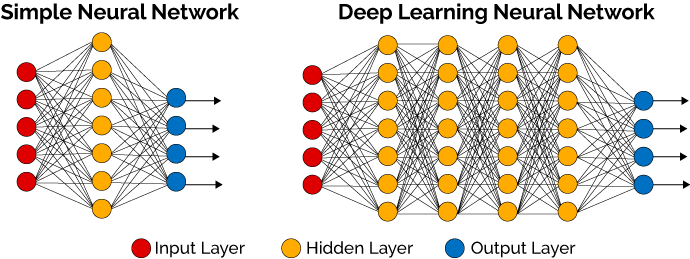
Image result for deep learning

Popular posts from this blog

Rectangular Microstrip Patch Antenna

Microstrip is a type of electrical transmission line which can be fabricated using printed circuit board technology, and is used to convey microwave-frequency signals. It consists of a conducting strip separated from a ground plane by a dielectric layer known as the substrate. The most commonly employed microstrip antenna is a rectangular patch which looks like a truncated  microstrip  transmission line. It is approximately of one-half wavelength long. When air is used as the dielectric substrate, the length of the rectangular microstrip antenna is approximately one-half of a free-space  wavelength . As the antenna is loaded with a dielectric as its substrate, the length of the antenna decreases as the relative  dielectric constant  of the substrate increases. The resonant length of the antenna is slightly shorter because of the extended electric "fringing fields" which increase the electrical length of the antenna slightly. An early model of the microst...

How to Set Up Guest Access on Ruckus ZoneDirector – Step-by-Step Guide

 Are you looking to configure guest access on your Ruckus wireless network? In this blog, we’ll take you through the entire process of setting up secure guest access using Ruckus ZoneDirector. Whether you're an IT admin or a network manager, this guide will help you create a BYOD guest WLAN, set up guest pass authentication, and secure your network with wireless client isolation. Step-by-Step Tutorial Includes: Logging into the Ruckus ZoneDirector controller Configuring Guest Access services for BYOD devices Creating a dedicated guest WLAN Using guest pass authentication for added security Isolating guest devices on the network for better privacy Accessing the guest network from a client device By following this tutorial, you'll be able to provide a seamless and secure experience for visitors connecting to your WiFi network. Check out our video tutorial for a detailed walkthrough! #RuckusZoneDirector #GuestAccess #WiFiSetup #BYOD #WLANConfiguration #WirelessNetwork #NetworkSecu...

Cracking Passwords Using John the Ripper: A Complete Step-by-Step Guide

Cracking Passwords Using John the Ripper: A Complete Step-by-Step Guide In today's post, we’re diving into a practical lab exercise that shows how to use John the Ripper, one of the most effective password-cracking tools in cybersecurity. Whether you're an IT professional or a cybersecurity student, mastering John the Ripper will help you understand password vulnerabilities and enhance your penetration testing skills. Lab Objective: The goal of this lab is to crack the root password on a Linux system (Support) and extract the password from a password-protected ZIP file (located on IT-Laptop). Both tasks are performed using John the Ripper. Steps to Crack the Root Password on Support: Open the Terminal on the Support system. Change directories to /usr/share/john . List the files and open password.lst to view common password guesses. Use John the Ripper to crack the root password by running john /etc/shadow . Once cracked, the password is stored in the john.pot file for future u...